Much like adjusting to life in Vienna—with its overwhelming abundance of cultural options—the festival became, for me, an exercise in discernment: the ability to choose, to prioritize, and to understand the parameters of what one notices and takes into consideration.
The 2025 edition of the Independent Space Index (ISI) took place from May 29 to June 1, opening 59 independent art spaces to the public, with an impressive total of 61 exhibitions and 76 special events. Much like adjusting to life in Vienna—with its overwhelming abundance of cultural options—the festival became, for me, an exercise in discernment: the ability to choose, to prioritize, and to understand the parameters of what one notices and takes into consideration. Over the course of the festival, I visited 41 spaces; nearly half of those featured in ISI’s ever-growing directory.
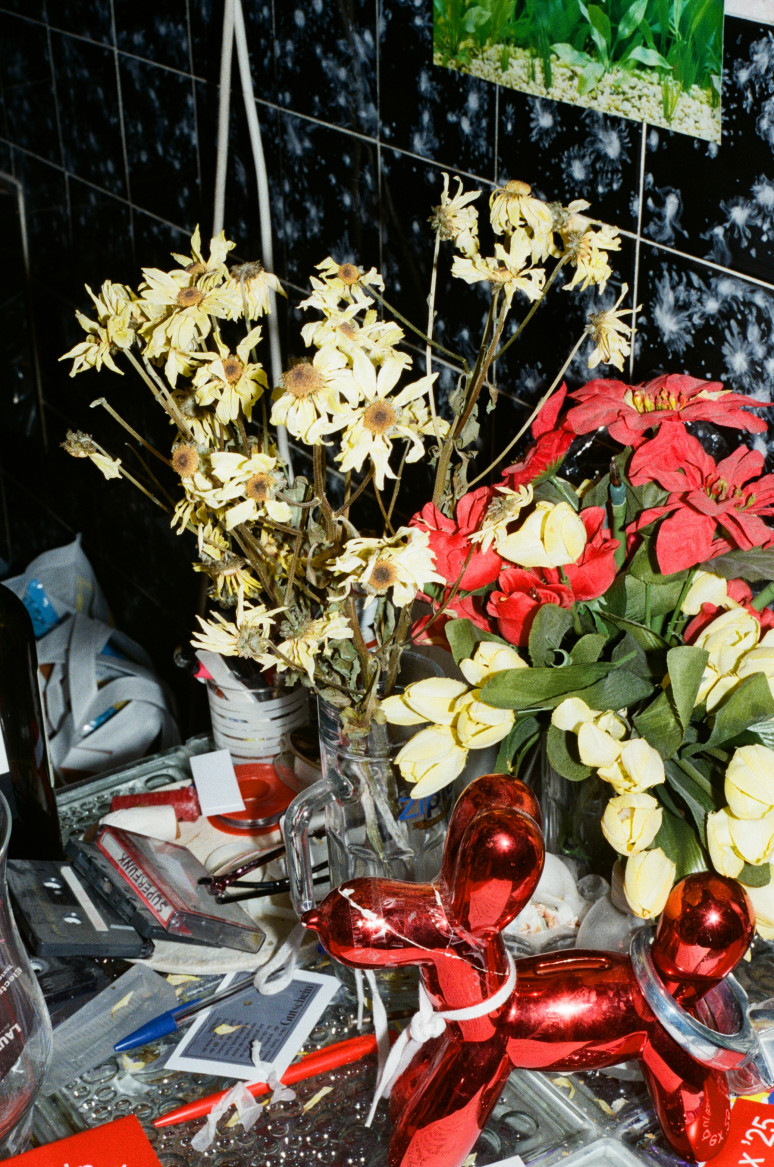
Independent Space Index 2025
Lukas MeixnerComing from a smaller and more contained art scene in Kosovo, the access to and plurality of expressions were both new and invigorating. My path to the spaces was informed by several interests: mapping trends and cultural specificities across the scene; comparative analysis of independent space models across regions; and documenting how “independence” is defined and performed. I was especially drawn to spaces that defied the white cube format, used language playfully, operated as collectives, and communicated their values directly, without obfuscation or over-reliance on theoretical jargon. What intrigued me most were the questions of resistance and positioning: are these off-spaces proposing new value systems for art? Or do they, despite their intentions, echo institutional norms? This text reflects on aspects of independence, language, and intention in relation to the festival experience, focusing on a selection of spaces and shows, grouped into categories that I found to be thematically overarching.
For the Viennese independent scene, reliance on public funding does not necessarily contradict autonomy, but instead shifts toward questions about freedom of programming, curatorial intent, or the refusal to conform to commodified art logics.
Independence in context: Reflections on language, legibility and framing
Having spent the past six months across Kosovo, Serbia, Slovenia, Hungary, and Austria, I noticed clear distinctions in how “independence” is understood. Towards the south, it signals survival outside of state structures. Moving northward, reliance on state funding and institutional support for experimental practices increases, and “independence” often means negotiating freedoms within it. For the Viennese independent scene reliance on public funding does not necessarily contradict autonomy, but instead shifts toward questions about freedom of programming, curatorial intent, or the refusal to conform to commodified art logics. This is a discourse less focused on resistance and more on negotiation, in comparison to Kosovo where support for alternative practices, outlying models of organization and a plurality of cultural expression is minimal, and constantly demands one “prove oneself”.
What becomes visible is that independence is not only financial but discursive: artists and organizers retain the freedom to (re)invent language around their practice and frame it with intention. In Vienna, this seems often to translate into artists becoming self-curators, curating text about their work to ensure novelty or legibility within funding systems, audiences, and curatorial networks. This layering of autonomy—both material and linguistic—reveals why definitions of “independence” among the spaces’ managers were so varied: for some it meant deciding their own timelines; for others it was the freedom to act within state-supported contexts; and for others it meant resisting simplification and embracing ambiguity.
Community-based spaces
Spaces such as Viktoria and Improper Walls dwell deeply in practices of community embeddedness.
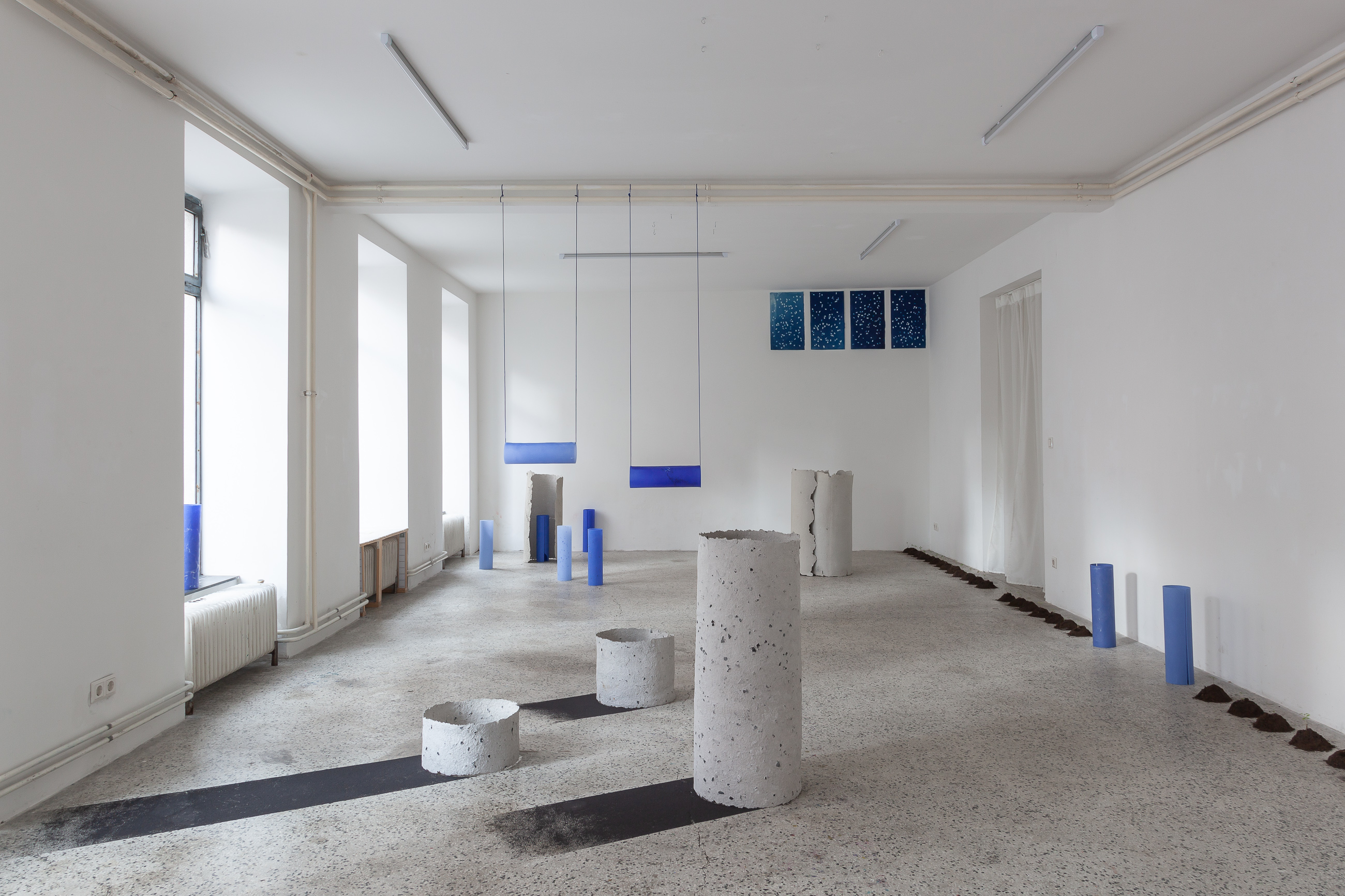
Viktoria centers on social design, neighborhood culture, sustainable living, and artistic engagement. Though I wasn’t able to document their programming in depth, I find such hybrid spaces more generative than conventional gallery formats. Martha Beauchamp’s “Light Injuries” offers a poetic invitation to attune to space through the lens of chronobiology, how bodily rhythms mirror environmental ones. Tubes, plants, cyanotype prints, wax, and paper pulp sculptures are scattered throughout the space and activated by cello and a microphone. Her work explores the dual nature of being both sound and object, rooted in a transmediation practice that translates neuroscience into visual and performative formats. With the parameters being growth, inhibition, injury, and regeneration, the show explores how “a body cannot adjust to any conditions” once its variables have been set, relocating or trying to make a shapeshift reveals information that must be handled with great attunement.
Viktoria
Flavio PalascianoImproper Walls, on the other hand, regularly depicts migrant perspectives, collaborations with artists from the Balkans and Baltics, bridging personal experiences of mental health issues, memory, and dislocation within broader political realities such as displacement or systemic precarity. The walls of the gallery remain black, a visual refusal to overwrite the weight of personal and collective pasts. The space is committed to building community care structures through socially engaged projects, such as crochet workshops for people affected by racism. The exhibition “Fragile Foundations”, echoes themes of home, labor, and mobility, and includes calls to collective action, reminding us of the complex processes of rebuilding identity when in transit. The project Strike imagines a “fictive yet legitimate” protest against future housing instability, evoking how the anxious mind replays past experiences as if they are bound to recur. In this way, the work feels both distant and strangely immediate: projected forward, yet rooted in a familiar tension, rendering one unable to act.
Raw, rugged, and intentional
ada (artistic dynamic association) operates as a spatial transgression, part living room, part bar, part exhibition site. Layered, rugged, and intentionally unpolished, it resists the sterility of gentrification and the aesthetics of institutional display. The exhibition “ada is… Under Pressure 2” animated the space through a dynamic dialogue between the different prints featured and the multi-patterned, carpeted walls left intact from previous use. This was a textured visual experience that blurred lines between domestic, social, and artistic environments. For me, few shows offered such space to craft one’s own understanding of what’s being viewed as this one.
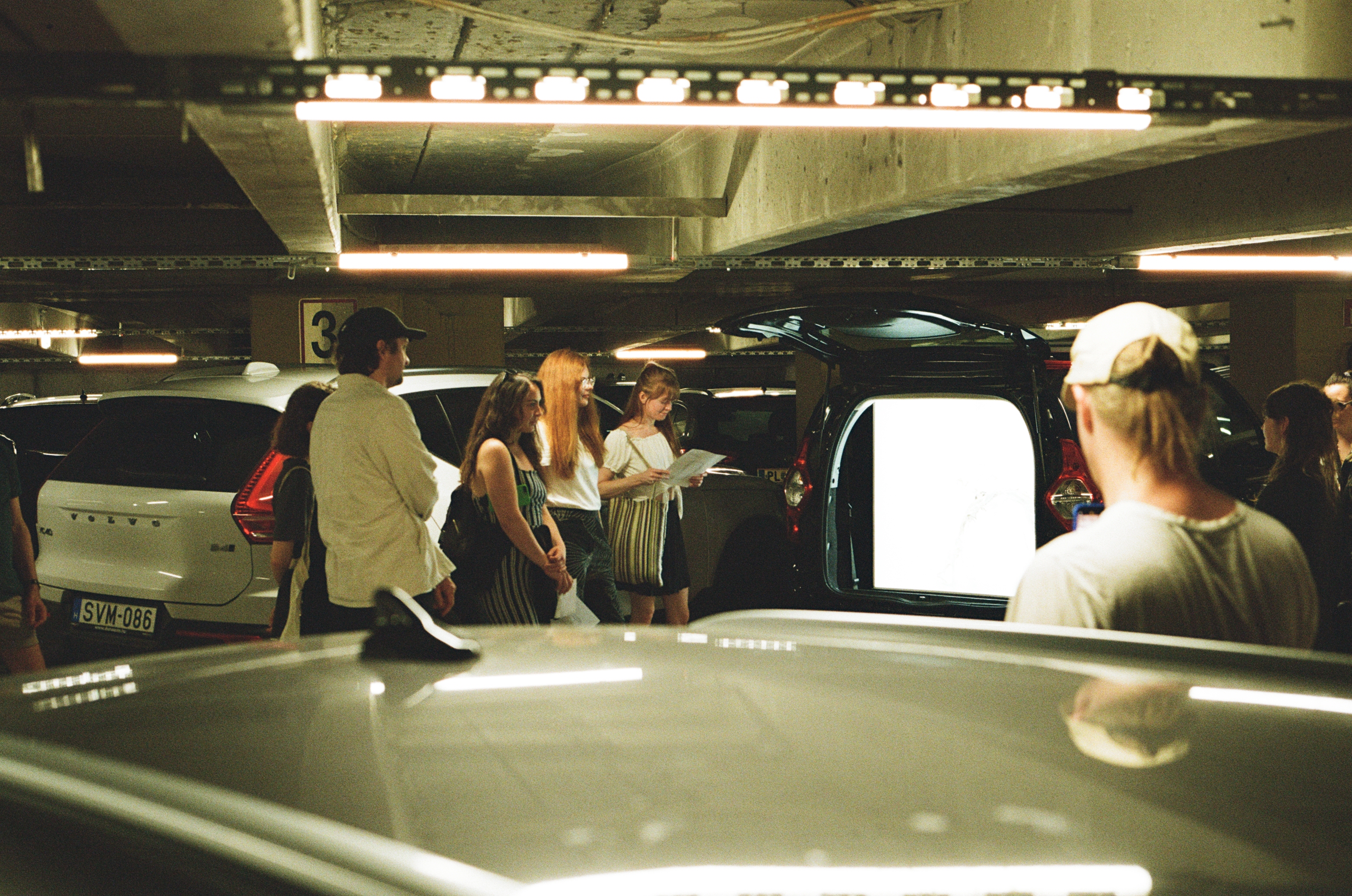
VAN by contrast, takes the white cube to absurd ends, exaggerating and ridiculing its conventions by mobilizing it as a nomadic showroom. ES49 likewise subverts the exhibition space, slipping away from the pompous intentionality we ascribe to white cubes. Their group exhibition “Fini la comédie” oscillated between satire and melancholy, a collective display where mockery, laughter, and irony served as aesthetic strategy and emotional release. Here, oppositionality doesn’t simply resist; it also entertains, producing moments of pleasure in critique and defiance—for example, the installation on the wall stating “I no longer respect your authority”, which seemed to have been rearranged in a feverish act, using objects from an Eastern grandmother’s home.
Van
Nikola HergovichWhile this democratizing impulse is commendable, it also opens up necessary questions about how we assign value to artwork and how distribution models shift perception.
Art in Unusual Places
How do these spaces qualify and quantify art? Do they propose new terms and methodologies for the onset, positioning, and realization of contemporary art pieces?
museum in progress is a decades-long initiative that brings artistic interventions into unexpected public contexts: e.g., riverside signage, museum curtains, mountaintops, and newspaper inserts. Now in its third year of the Raising Flags project, the initiative has produced 70 flags in collaboration with 37 artists. For this edition, Jonathan Monk contributed four new designs, installed on the Studenbrücke during the festival.
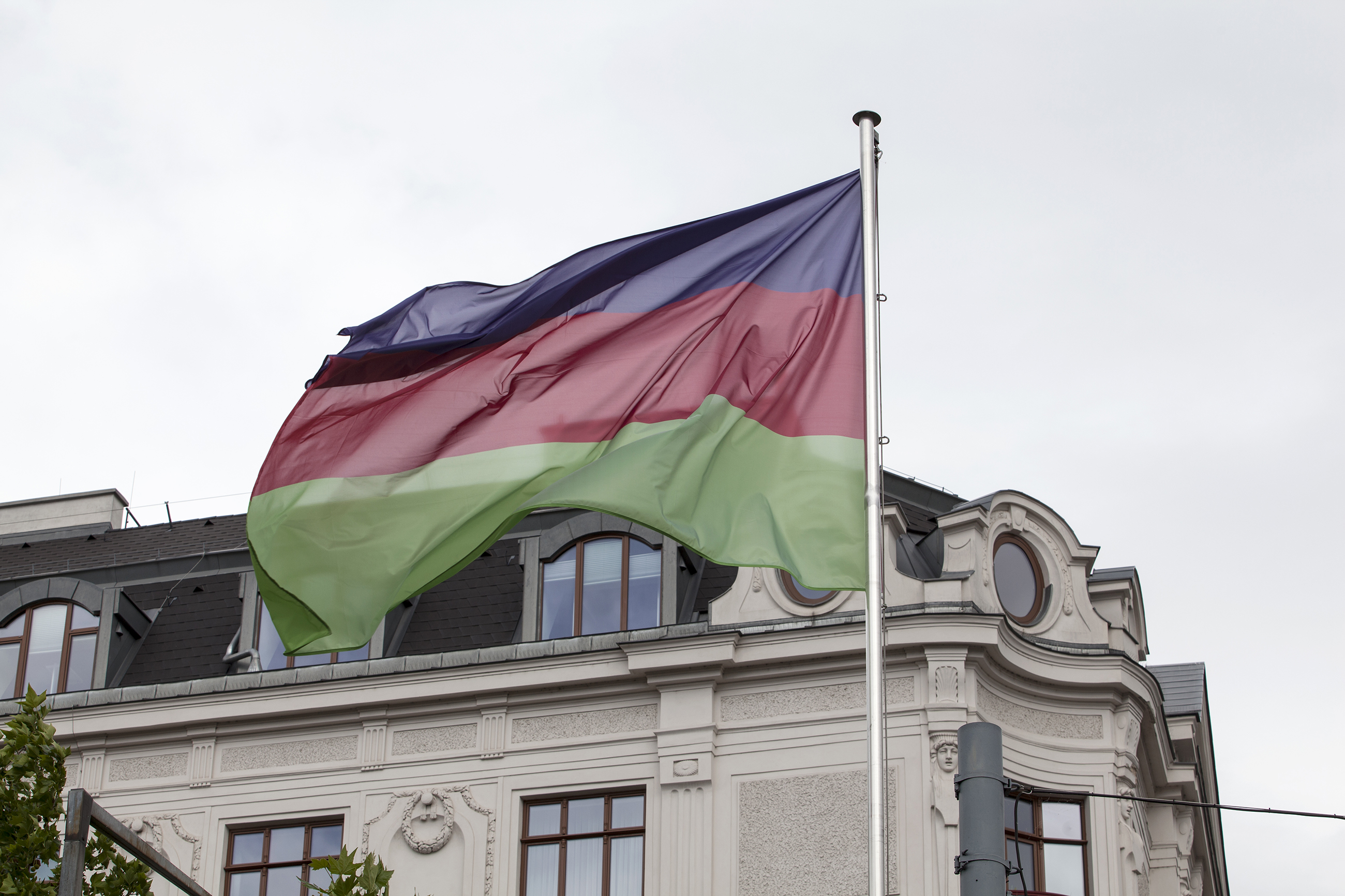
At first glance, seen in isolation and without contextual mediation, the flags may appear minimal or even underwhelming. But they gain complexity when situated within the project’s long lineage of artistic reinterpretations of the flag. A seemingly simple medium becomes a layered signifier, tapping into the flag’s powerful role in our collective unconscious, not merely a tool for visibility and identity, but a site of symbolic residue and political tensions.
Over the years, Museum in Progress has realized over 300 billboard projects and 1,500 newspaper-based works, framing these interventions as “art collectibles” and advocating for broader access to art ownership. While this democratizing impulse is commendable, it also opens up necessary questions about how we assign value to artwork and how distribution models shift perception.
Collectives & Feminist Modes
Im_flieger is a space dedicated to dance, performance, and transmedia art, operating along the porous boundaries between process and product. It consciously positions itself outside of art’s consumable logic, prioritizing works-in-progress over polished outcomes and favoring open, evolving formats over fixed aesthetics. As a collective with a flat hierarchy, Im_flieger fosters transgenerational knowledge-sharing and artistic exchange. As part of Index, they hosted for the third time Embodied Perspectives, a public program of shared practices addressing embodied perception and participation, led by performers and choreographers who are part of their network.
The Queer Museum Vienna is an initiative that actively queers the museum format - both in its curatorial approach and physical placement. Housed in the Otto Wagner Areal, a former psychiatric ward reported to have experimental treatments done on autistic children and queer women throughout the 20th century. It was decommissioned only two years ago. Against this backdrop, Gaps, Fractures and Leaks: Queer Temporalities offered a grounded and accessible entry point into both localized and global forms of queer resistance and representation, articulated through painting, textiles, video, poetry, and immersive media.
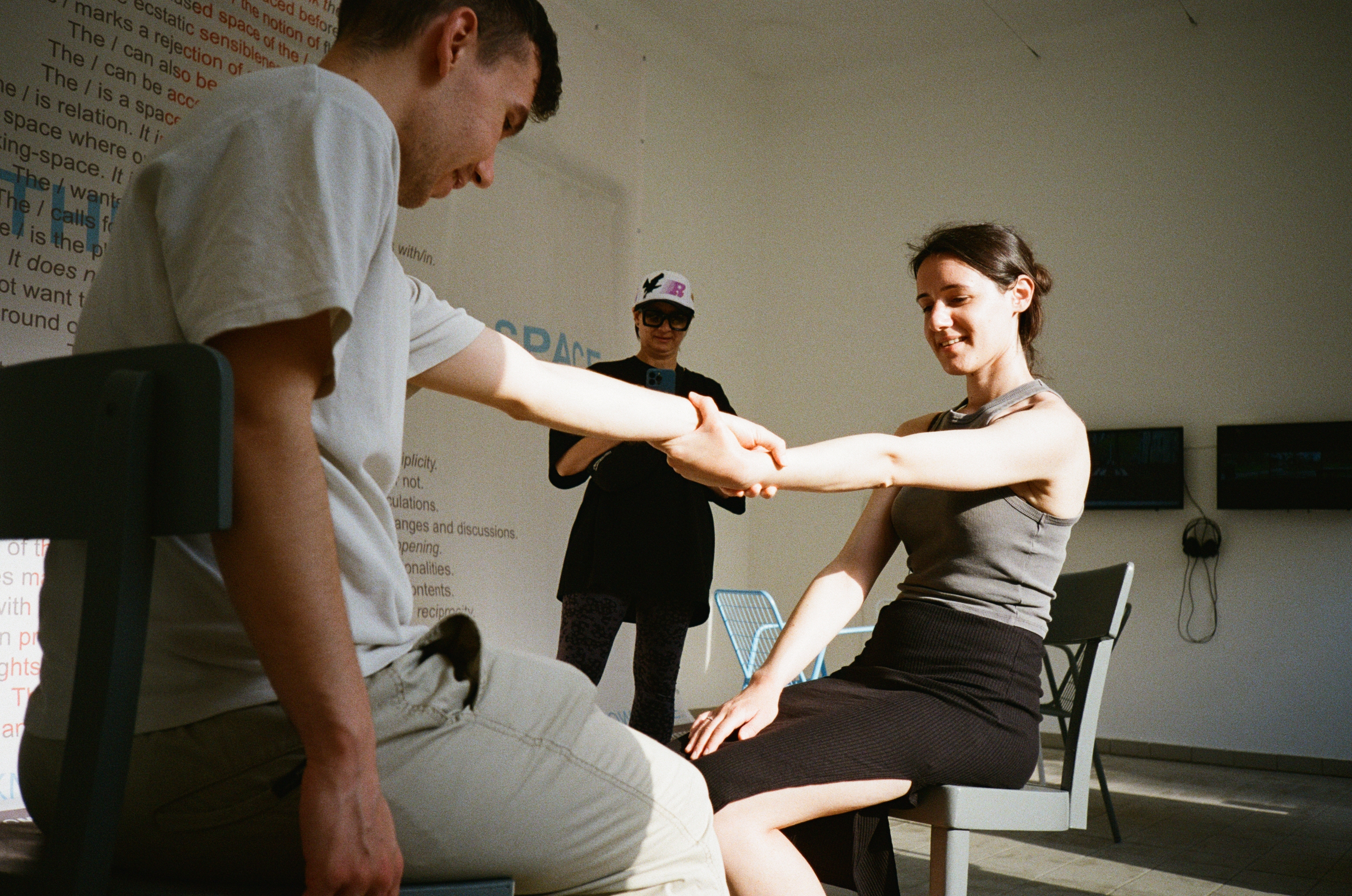
Mz*Baltazar’s Laboratory is a feminist hacker space redefining the intersection of art and technology through participatory formats, critical language, and the politics of visibility. I was particularly struck by the work of Ingrid Cogne, whose exhibition was on view during the festival. Cogne’s practice is rigorous and deeply intentional; her works act like tendons, structures that bind and animate, creating constructed situations which channel from what’s taken for granted in the everyday. Her attention to language and life is both precise and poetic, making visible mechanisms of power and presence that usually remain invisible.
On technology as practice, tool, and method
At Kunstraum am Schauplatz, the double exhibition of Andy Guhl and Olga Titus simulates digital and virtual wanderings through now-obsolete technologies. Titus’s paillette-based digital prints and Guhl’s analogue electronic systems—crafted from salvaged, broken everyday objects—form a curious interplay of glitter and glitch. Together, they seem to reconstruct a sense of virtuality grounded in the physical, offering a materialized reflection on how digital perception once felt.
-
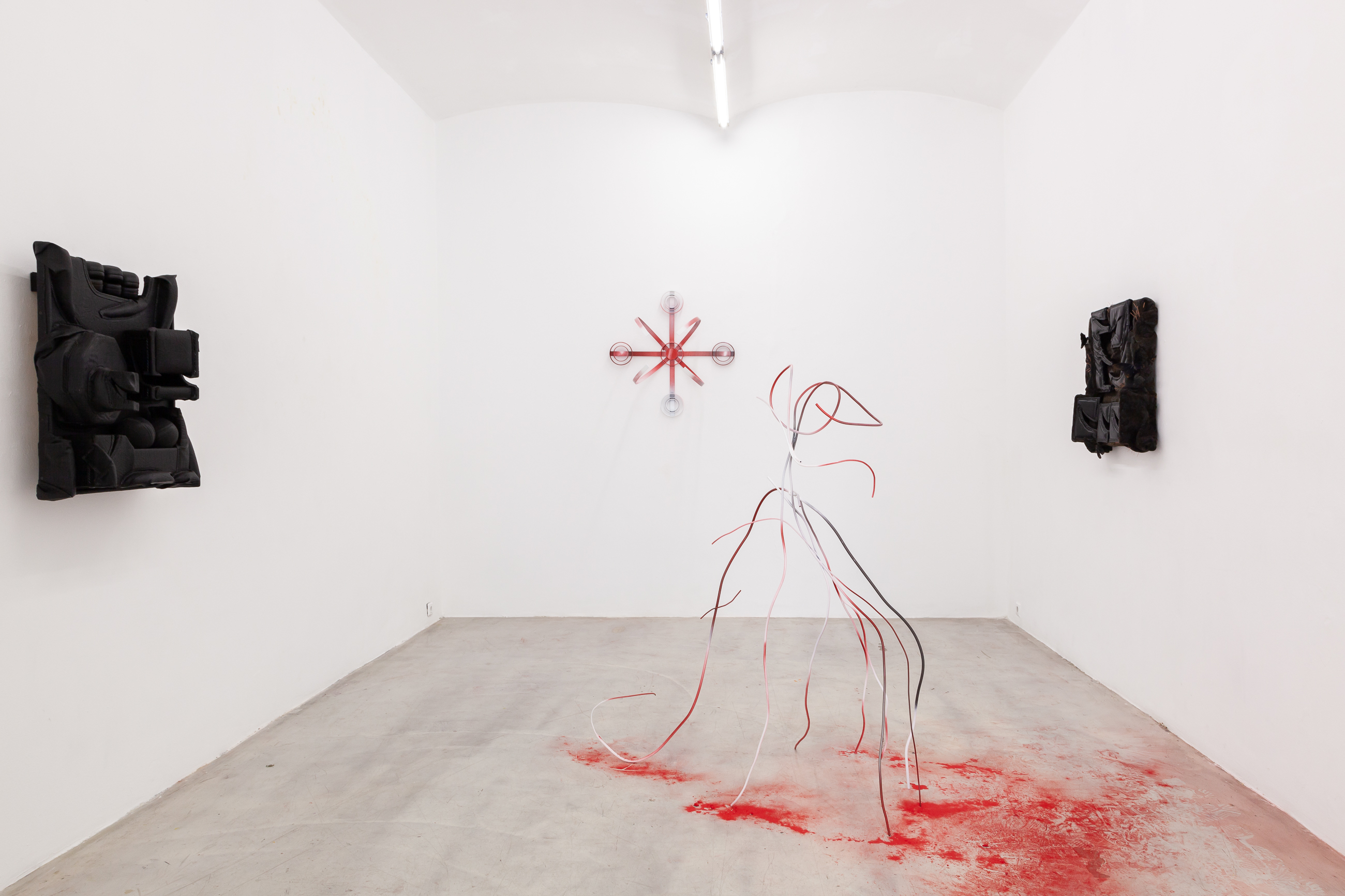
Zuza Golińska x Cezary Poniatowski: Remnants of the Current at WAF
Flavio Palasciano -
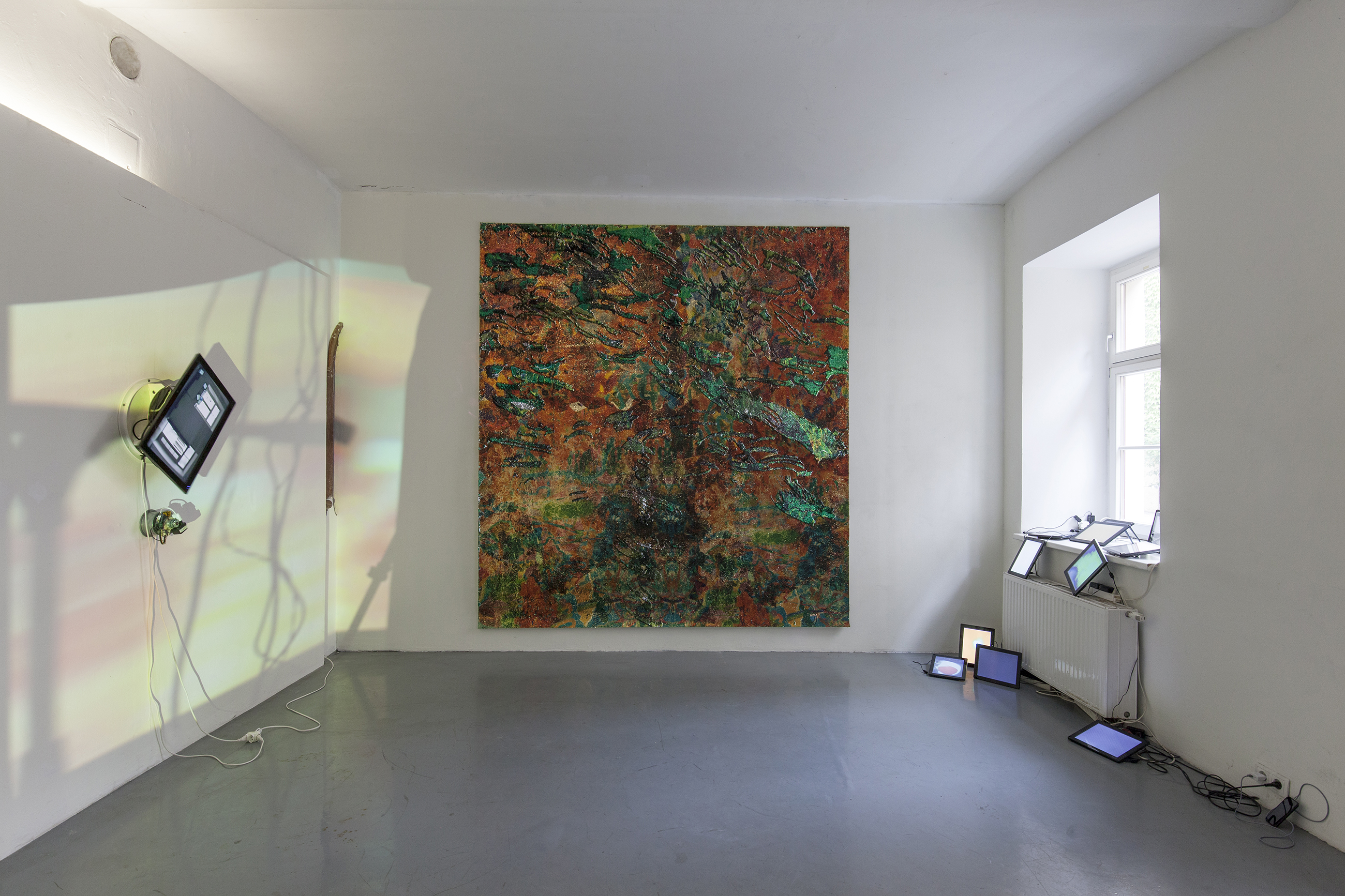
Olga Titus / Andy Guhl: Resonanz, Lichtrisse und Schalltritte at Kunstraum am Schauplatz
Flavio Palasciano
At first glance, the work of Cezary Poniatowski and Zuza Golińska at WAF evokes a dystopian landscape of retro-futurist doom. Beyond that initial impression, their pieces establish a compelling visual dialogue. The constructions, composed of leather, metal, carpet, and paint, are unlikely architectures, “worlds within worlds”. While the materials recall post-communist industrial decay, they seem to me to suggest speculative reconfigurations. It’s not merely affirmation of destruction that they offer, but improvised potentialities stitched from ruins.
NODE Media Lab, situated in the ORF Funkhaus building, centers on new media practices, with a particular focus on AI and AR. The group show “Deep Skin” doesn’t dwell on medium or process; instead, it steers thought toward the embodied consequences of mediated life. What struck me in particular was how the works invoked the body, not as a stable form, but as a site of trauma. Here, trauma becomes both a wound and a catalyst for becoming. Rather than framing technology as alienation, the exhibition gestures toward a more generous reading: that technological rupture might not simply divide, but also offer means to reconcile contradiction, and to reimagine the self.
On wording practice
Salon für Kunstbuch is a 30,000-book installation that treats printed matter as art object and as spatial language. Its creator, Bernhard Cella, is a meta-narrator within the space—present and performative—often introducing a moment of rupture for visitors by declaring: “This is not a bookstore.” Cella operates in tandem with the “cellular consciousness” of the books, which are constantly restructured in thematic, color-coded arrangements. The display is never static. His curatorial hand is visible, precise, and unapologetically partial. As he puts it: “The act is exclusion… only nothing is neutral.” Here, selection becomes gesture, and gesture becomes philosophy.
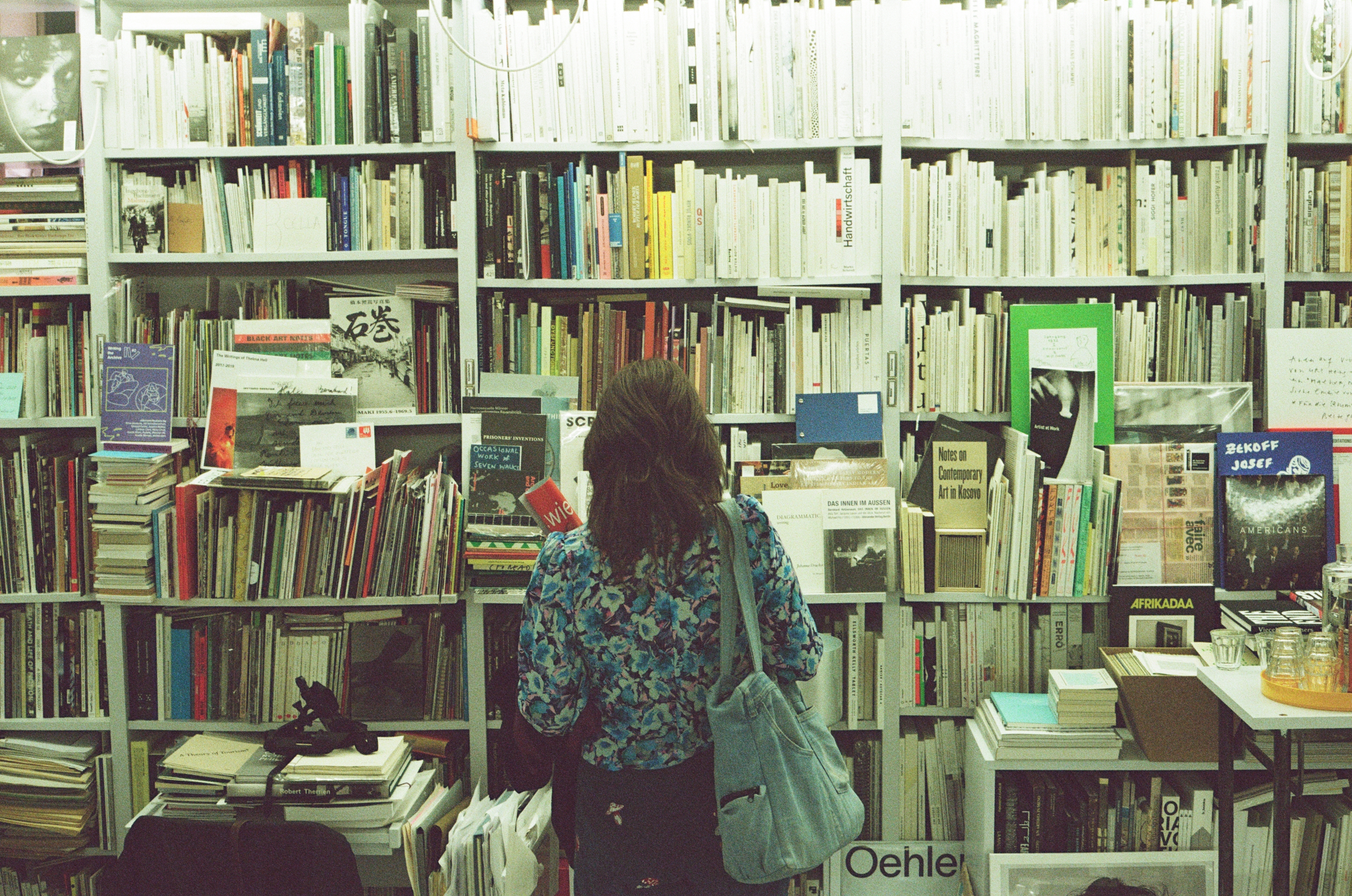
Salon für Kunstbuch
Nikola HergovichThis is not a bookstore.
Prosopopoeia features text- and language-based works. The show “tout va bien” explores the presence and violence of language. Ethan Assouline’s pieces are renditions of children’s educational materials and elemental classroom objects: books, clocks, and doors. They are presented as familiar objects hollowed out and reconfigured. What remains is not their function, but their structure, shells animated by a new interior logic. The show opens a space for exploring silence and negation, not as voids, but as committed, constructive positions. In doing so, it gestures toward a deep awareness: language can wound; thus, the ability to redefine, reshape, and create new forms must be retained by all: an active pursuit of personal agency, though hushed and reticent.
Disillusionment, affect, and everyday fictions
flat1, formerly a concierge room, has evolved into a space for international collaboration. This year’s theme touches upon collective anxieties, fears, and the intimacy of insecurity. It prompted a turn toward collectivity as a response to increasingly privatized forms of handling distress. In this context, Mahony Collective presented installations, sculptures, and prints exploring magic and disillusionment. Rendered in blue and white hues, the works unfold subtly, revealing, for the attentive viewer, both the emotional rupture and the need for validation that comes with being deceived and recognizing it.
At 20 20, Christian Egger constructs a philosophical labyrinth through language and form. His voice, at once disarmed and lucid, poses elliptical provocations: “One hears, one does not take, one takes, one does not ask who is giving.” Through this layered phrasing, Egger probes the limits of choice, the structures of conditioning, and the poetics of absence. His work invites us to walk the tightrope between autonomy and influence, between asking and receiving, between word and wound.
These initiatives resist the slow homogeneity creeping into artistic production through gentrified urban zones, institutional formalism, and market logic. Yet, as much as these spaces operate with urgency and sincerity, one question lingers: where does intention end and effect begin?
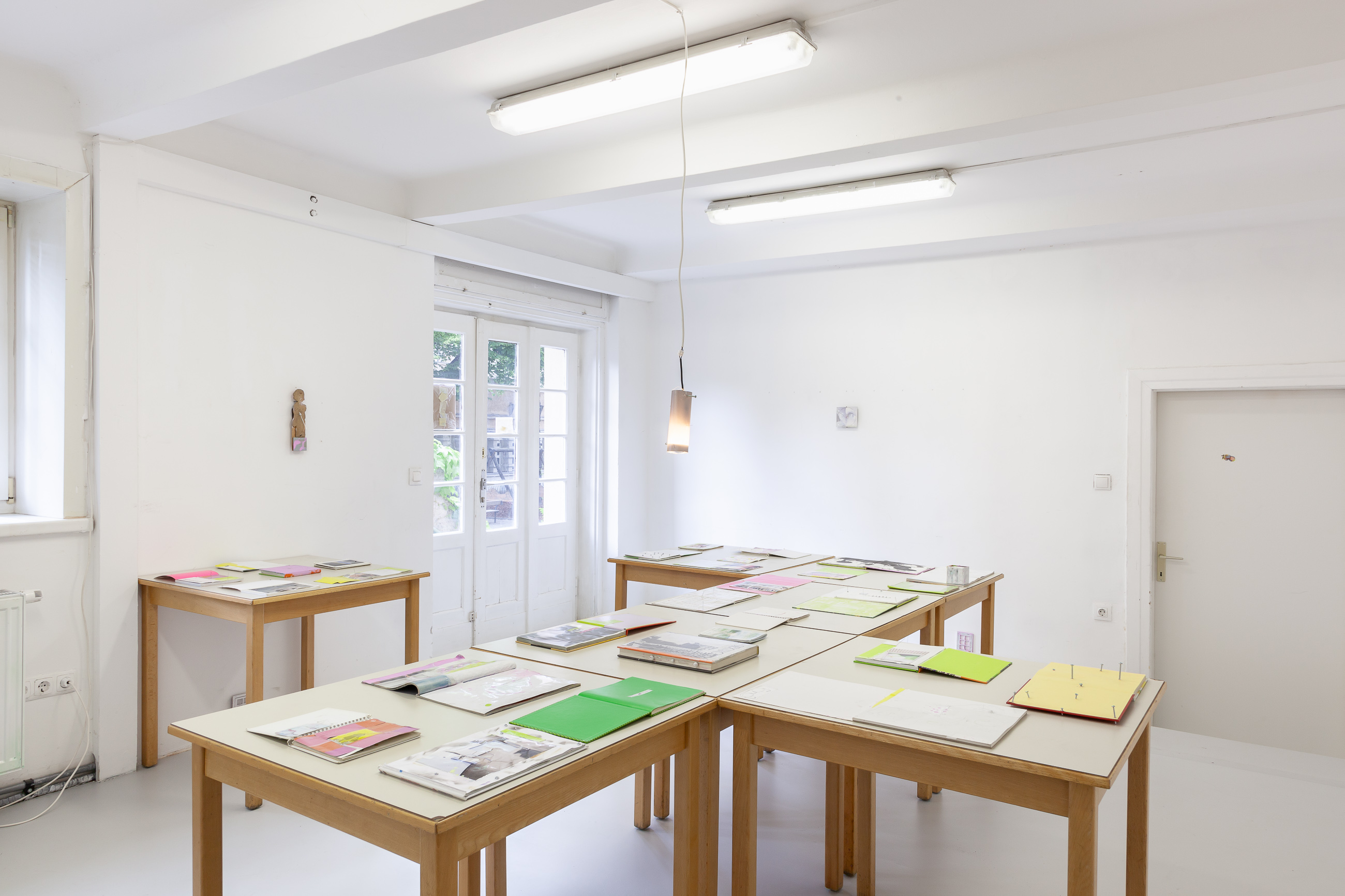
Prosopopoeia
Flavio PalascianoIndependent Space Index is more of a cultural cartography: relational, situational, and sometimes contradictory. What becomes apparent here is a shared disposition: these initiatives resist the slow homogeneity creeping into artistic production through gentrified urban zones, institutional formalism, and market logic. Yet, as much as these spaces operate with urgency and sincerity, one question lingers: where does intention end and effect begin?
Many of these initiatives gather loyal publics and operate with deeply personal stakes, sometimes running the risk of becoming self-referential, addressing the needs of the initiators more than those of a wider public. But perhaps that is part of their function: to carve out spaces of autonomy and idiosyncratic vision in a landscape already saturated with finality, spectacle, and expectation. Luckily, the Viennese art scene is large and textured enough not to demand every space justify itself through legibility or accessibility. It acts not as a centralized stage but as a polyphonic terrain, populated by fractions of practice, style, and arguing for the potential of art to exist otherwise in the very act of creating new metrics and assigning one’s own meanings.
About the author
Diona Kusari is a multidisciplinary artist, writer, researcher, cultural and arts mediator based in Kosovo. Her work spans performance, video and sound art, installations, short films and participatory events. Her artistic work is concerned with illustrating the “unseen” in terms of ideology, faith, and folk practices, and challenging the apparent dichotomies and delineations of private and public space. She is a member of the transdisciplinary collective Potpuri, whose work focuses on experimental research and print practices, and decentralized knowledge production. She is currently researching the independent and alternative scenes in the South, East, and Central European regions.