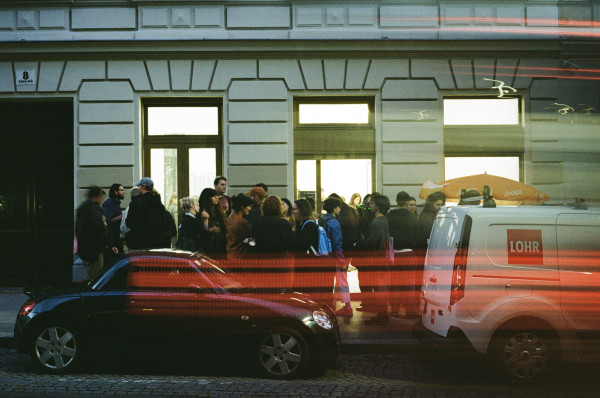
Independent Space Index 2024 kicked off in Vienna on a Thursday evening at the end of May, with 52 of the network’s 90 listed spaces opening their doors to the public over one weekend, rather than the appointment-only or irregular opening hours by which many of them normally operate. Anticipation ensued.
The task of plotting an itinerary was made significantly easier by the free printed brochures distributed throughout the city, recognizable by the blurred red and white oval halo repeat pattern across their covers. This was in addition to a clever website to help those uninitiated in the ways of Vienna (myself) navigate neighborhood clusters and stating which spaces had events on which days.
Based on these guides, Thursday night offered a smooth 6th District run, with the exhibition Autorn opening at WAF, along with a film screening and book launch at Salon für Kunstbuch, and the exhibition Mermaid & Seafruit at Ve.Sch. Respective friends, fans, and social circles can arrive, linger, depart, refuel at McDonalds, then re-arrive at leisure, text friends along the way, or look at Instagram to see what’s up and make a plan to unite at the next space. Most locals know that Ve.Sch is where finales typically occur on Thursday nights in Vienna, and where the cocktail mixing of the owners’ (probably extensive) repertoire of hobbies turned skills, can be experienced.
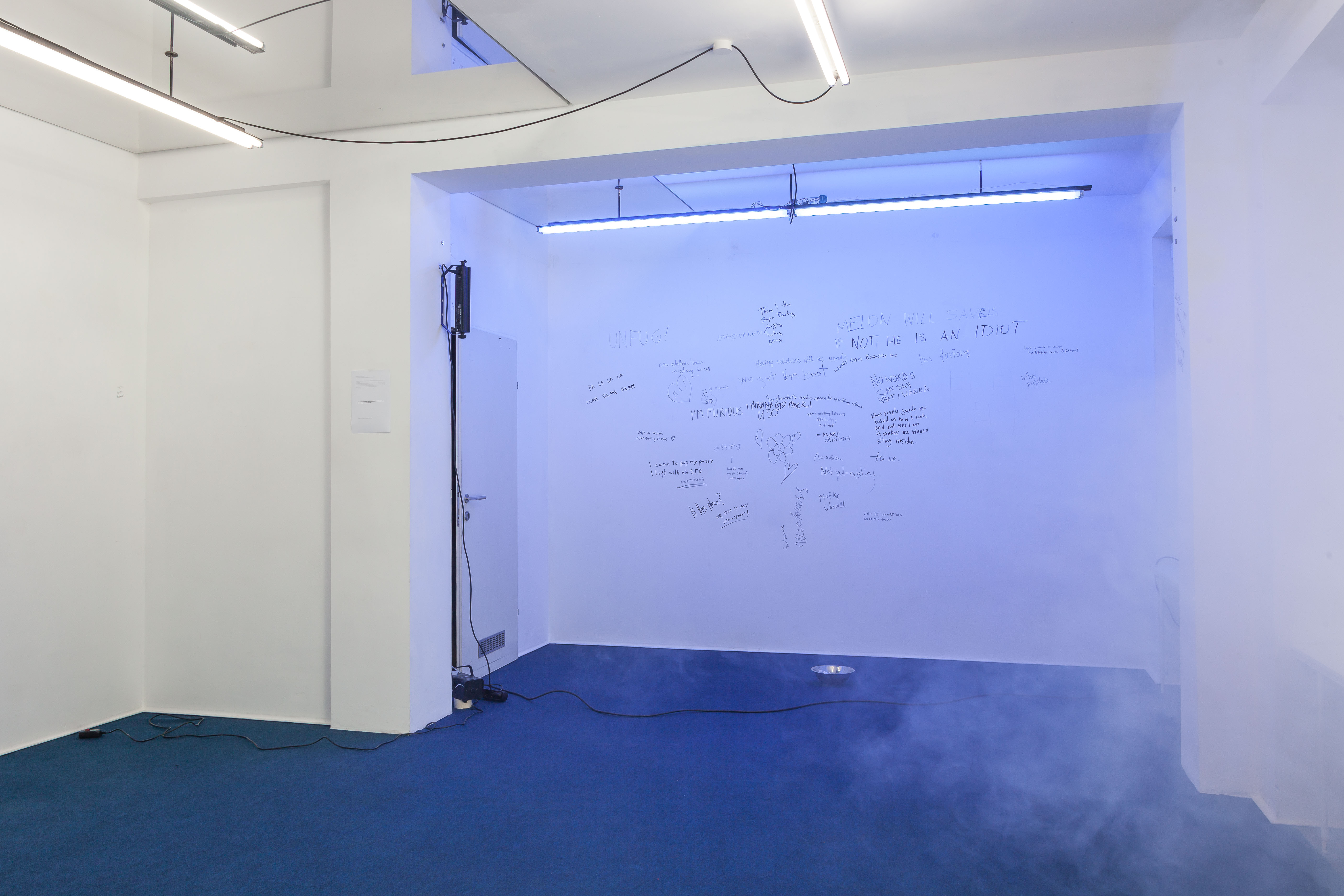
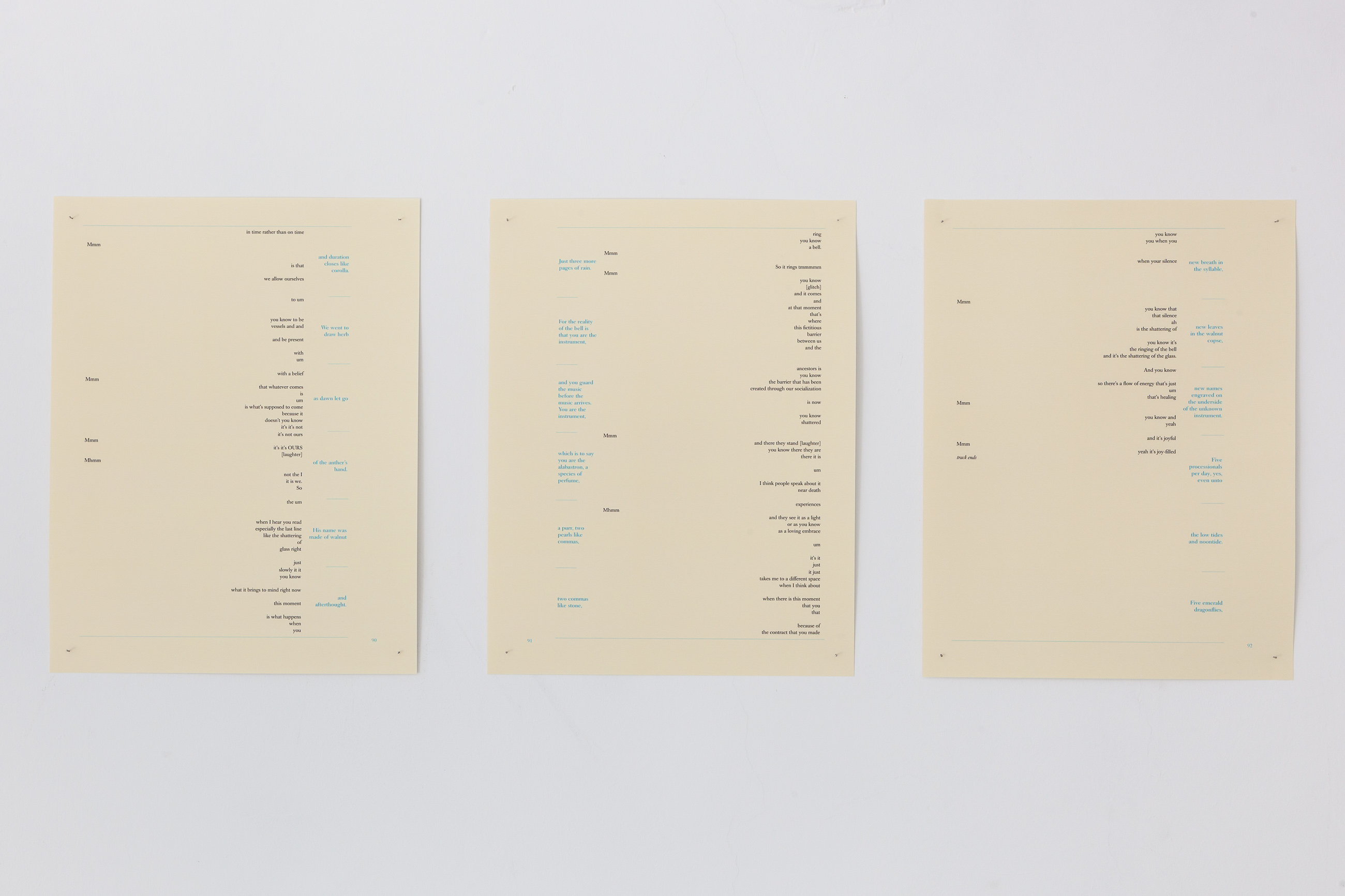
Earlier in the day, I visited one space that I had been looking forward to visiting for the first time, Prosopopoeia. The name refers to a rhetorical device in which a speaker or writer communicates by speaking as another person or object. This project space was initiated by Inga Charlotte Thiele, who came across the American-based artist JJJJJerome Ellis while working at PW Magazine and later invited him for this exhibition. The multiple J’s in Ellis’ first name refer to the stutter he lives with and which his works often are informed by, incorporating it into his written and visual poetry as well as his performances. Working not despite but rather because of his stuttered speech, Ellis contests the “social regime of fluency”, finding another rhythm through spoken word within which time is created by the moments in between. I thought of Fred Moten saying: “Anyone who can’t help but deviate can pretty much tell me anything.” A sequence of photos of the artist in the woods references the idea of a “clearing” in the forest where one happens upon a meadow, analogous to clearings as “ever present clarity” as the exhibition text notes, or moments of silence during speech when one is trying to figure out the next word. On a perpendicular wall to the photos, poems formed in scores rather than stanzas are hung without frames. The soundtrack to the exhibition of Ellis’ meandering images is a spoken word performance emanating from speakers near a corner with a short shelf holding an intuitive selection of books. It was refreshing not to gauge any formal or obvious concept behind the book selection, instead I felt a sense of reflected pride in recognizing some friends’ publications, as well as relief in finding authors and titles that I had searched for in Vienna but could not locate. With JJJJJerome’s language punctuating the background, the opportunity to sit and peruse the shelf to the beat and unexpected breaks reflects an intimacy only an independent art space can evoke.
Accurately self-described as a bookshop, host, and exhibition space, Prosopopeia is located within a Gemeindebau, the name given to Vienna’s social housing, with the artist and neighbors forming parts of the same milieu. To make use of available and affordable space in Vienna as an opportunity for offering literature and printed matter otherwise unavailable in the city is just one of the myriad ways independent spaces provide alternatives within the social system. This kind of space repurposing serves the city’s changing demographic of artists, writers, readers, and scholars, or, in other words, comrades and peers. While I was sitting near the window engaging in the aforementioned texting well before dusk, a friend approached and we chatted about her new, bigger, studio space. “So I’m going to become a painter now,” she laughed. The time and space provided by Vienna’s relative affordability make it possible to develop long-nascent art practices. In some other major cities’ artistic scenes such as in New York, and even now in Berlin, continuing an art practice often means figuring out how to commercialize it in another industry. Vienna’s infrastructure also makes it possible for people to come into art later in life, and to understand the artistic side of their work in other fields, or to develop practices quietly without the pressures of chasing visibility for the sole purpose of selling work.
The fluidity of artistic practice and space in Vienna encompasses literal mobility. Sophia Hatwagner’s space called VAN opened in 2020 inside a gifted Dacia. With a constructed white cube inside a minivan, Hatwagner could have her own mobile space while attending to her new daughter, thus playing with and circumventing the restrictions of the white cube and the need to regularly attend openings as required for building an artist’s social and cultural capital. Part institutional critique, part experiment with temporal and financial modes, the exhibitions the space holds vary widely in form and content. This is reflective of VAN’s concept of privileging mobility over fixed identity. Understood as a “nomadic” space, VAN rejects any stable form, and instead embraces an independent space’s loose requirements, with no demands to adhere to material promises. It can morph according to a moment’s needs, as a response or a survival skill, without imposing what art should look like and where it should be found.
For the festival artist, Stefan Pani presented (Curatorial Exile), through which a meta-narrative appears to critique the ideology that lies beneath the white cube. The work is part of his larger project Post-Innovation. According to Pani’s Post-innovative staging, “the core of the curatorial agenda, as well as the individual contributions is to generate relevance through value production in the realm of autonomous spaces,” Pani is referencing Boris Groys’ concept of artistic innovation. Pani’s ‘individual contributions’ are those made by three fictional artists, whose roles seem to be to amplify the meta relationship of the white cube in a van, as well as to raise questions of authorship. With the aid of a text revealing a sequence of events that make up Post-innovative Staging, including the introduction of a rag and an identical van, the presumed curatorial text of (Curatorial Exile) raises an inevitable question: at which point does the institutionalization of new spaces, which demand both their independence and aesthetic autonomy, become apparent? Could this also allude to the festival’s potential institutionalization of the decentralized scene?
At which point does the institutionalization of new spaces, which demand both their independence and aesthetic autonomy, become apparent? Could this also allude to the festival’s potential institutionalization of the decentralized scene?
Vienna’s independent scene is not exactly fringe, but rather a network running in parallel with, and occasionally running into, the city’s institutionalized and galleried art world. Still, like in any network, with the social aspect comes cultural codes that you either get or you don’t, or which you learn over a process of initiation and rehearsal from each others’ networked positions. In general, Vienna’s independent space scene has evolved not solely to subvert the closed bourgeois circuits of the art world, but also by incident, by way of finding loopholes through which to bypass imposing societal orders, hierarchies of dominant values, politics, and culture. Through proverbial handshakes, the handing over of keys, and the trusting of someone else to lock up, networks are built on trust and word of mouth, where aesthetics, rhetoric, and spatial organization are linked more to chance and informal communities than to established forms of gatekeeping. Being discreet is a necessity when the figures of friend, lover, colleague, collector, or gallerist are regularly interchangeable. Yet unlike other art worlds, the independent space scene does not appear to discriminate based on social status. As a friend, an established artist in Vienna for 20 years, put it, “Everyone talks about each other, but everyone likes each other.” These are the deliberate acts of organized creativity and conscious interactions that make a scene desirable in the first place. It is not premised on immediate exclusion, but rather on a built trust, and such trust has to be earned.